Binrem
Binrem™ BeeBloom Water Bowls
Binrem™ BeeBloom Water Bowls
Não foi possível carregar a disponibilidade de recolha
The Silent Summer Crisis: Why Your Garden Has Gone Quiet

Senior Editor | Living Nature Magazine
"A puddle on hot pavement won't save them." — How a 64-year-old potter from the Blue Ridge Mountains unintentionally uncovered the hidden reason bees are disappearing from our backyards.

What bees need is simpler than you think – but often harder to find than it seems.
Weaverville, North Carolina, March 2026. Think back to childhood summers—the constant hum that filled the air. It wasn't just a few scattered bees; it was a living, steady vibration across every sunlit garden. Most of us never noticed when it faded. One summer, we simply realized it was gone.
Bees are clearly struggling, and that much is widely acknowledged. But what many gardeners don't realize is that pesticides and habitat loss are only part of the equation. In the height of summer heat, bees are also quietly dying from dehydration—and it's happening in the very places we think of as safe: our own backyards.

The Hidden Crisis in Extreme Heat
When temperatures climb, bees don't behave like they normally do. They abandon nectar and pollen collection and shift into survival mode—focused entirely on one thing: water. A single hive can need as much as half a gallon on an extremely hot day, just to keep itself cool.
The problem is where that water comes from. Natural sources—morning dew on leaves, the edges of small streams, damp patches of soil—dry up or vanish quickly under intense heat. In desperation, bees start taking risks. They land in overheated rain gutters. They drink from roadside puddles laced with oil and tire dust. They try to use birdbaths that are too deep and end up drowning.
Sarah Jones had noticed this pattern long before it began appearing in gardening articles.
"He wanted to give me something that wouldn't wilt"
Locally in Weaverville, she's simply known as Sarah. For the past fifteen years, she has worked as a dedicated studio potter, crafting pieces in a small workshop behind her home. The space holds a kick wheel, a wood-fired kiln, and shelves filled with jars of glaze she blends herself. Her path into pottery began with a birthday gift from her husband, Charlie—a class he chose because he wanted to give her something that wouldn't wither or fade. She tried the wheel once and never really stopped.
Early on, she developed a defining form: the poppy bowl. Open and soft in shape, with a subtle dip at the center, it came to her almost instinctively. "It just came out before I had time to think," she says. "I glazed it, fired it, and when I pulled it from the kiln, I just knew—that was it."
From the next year onward, it became a tradition. Each birthday, she created a new ceramic poppy bowl for Charlie. Over the course of fifteen years, dozens of these bowls accumulated in their garden, resting among black-eyed Susans, wild clover, and real poppies. No two were ever exactly the same, each one carrying subtle variations shaped by the natural unpredictability of the firing and glazing process.

In the flower bed, they're nearly impossible to tell apart from real blossoms. That was always the joke — and the whole point.
Charlie, a beekeeper with over 35 years of experience, became the unexpected trigger for what came next. During an intense heatwave, he simply acted on instinct—pouring sugar water into one of Sarah's ceramic poppy bowls. There was no theory behind it; just a practical attempt to help his struggling hives.
By the following morning, three bees were already perched on the rim, drinking.
What followed became a quiet, fifteen-year fixation. Each summer, she refined her designs—producing hundreds of variations, adjusting small details based entirely on bee behavior. She never sold any of them, only gifted them to friends and neighbors.
"A bee doesn't drink like a bird. It took me a long time to understand that."
Sarah takes two bowls down from a dusty studio shelf. One is an earlier, flatter version; the other is her current design, with a deeper center and a rim that gently curls inward.
"That first batch was basically a failure," she says with a short laugh. "It was too flat, and the glaze was too slick. Bees would land, slide off, or just avoid it completely."
She sets it back down and continues: "A bee needs a place to grip. It has to feel stable when it lands—no risk of slipping in. And the water has to be shallow enough that it can stand comfortably while it drinks."
What Sarah learned after 15 years of close observation:
🐝 Shape is a signal. Bees move through the world by reading flower-like shapes. A rounded, open ceramic bowl set among real plants doesn't register as an artificial object—it blends into their perception as something natural to approach.
🐝 The rim is everything. If the bowl is too shallow, bees slip off. If it's too deep, they risk falling in and drowning. Her current design sits in a careful middle zone that allows safe landing and easy access.
🐝 Surface texture matters. A perfectly smooth, glossy glaze offers no grip. Bees need friction to hold their footing. For that reason, Sarah intentionally leaves the rim slightly less polished, giving them a stable place to land.
🐝 Location is key. When positioned in the shade of a flower bed, water evaporates far more slowly than in a plastic dish left on sun-heated concrete. The result is cooler, longer-lasting water.
🐝 Clean water saves hives. Water from roadside puddles—often mixed with oil and tire residue—can gradually weaken a colony over time. In contrast, fresh water provided safely in a garden setting can function as a critical support during extreme heat.

The depth of the rim, the width of the opening, the glaze finish—none of it is decorative by chance. Every detail reflects fifteen years of patient observation.
The 10-Second Morning Routine
What makes Sarah's solution remarkable is how simple it is. The bowls are placed on metal stakes pushed directly into the ground, sitting at roughly the same height as the surrounding flowers. No digging, no bulky birdbaths to scrub, no stagnant water left baking on hot concrete.
"I just top them up every morning," Sarah says. "My watering can is already out for the plants anyway. It takes maybe ten seconds. Then I step back and see who shows up."

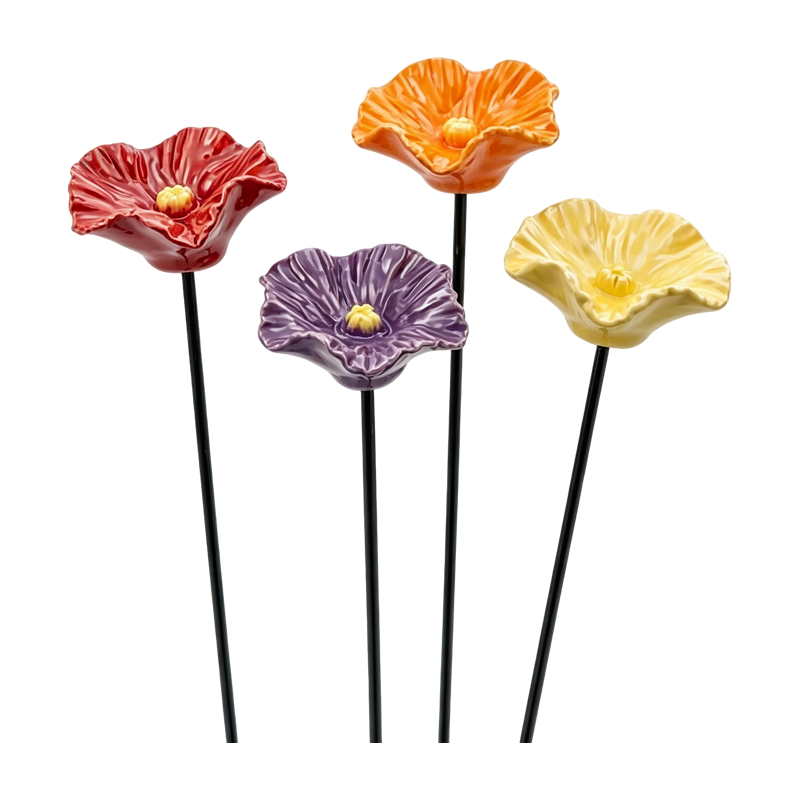
A 4-piece set in mixed colors—pink, orange, purple, and soft yellow—each one unique. No two bowls are ever the same.
✅️ Designed from 15 years of field observation — rim depth, opening size, and wall angle are all calibrated to match real bee behavior, not decoration
✅️ Carefully made ceramic construction — shaped, glazed, and kiln-fired individually; slight rim texture is intentionally left to give bees a secure landing grip
✅️ Garden shade advantage — placed among plants, the bowls stay shaded, slowing evaporation and keeping water cooler than exposed ground-level containers
✅️ Effortless daily refill — just a quick ten-second top-up with a watering can each morning
✅️ Blossom shape as a signal — the rounded, open form mimics blossoms, making the bowls feel like a natural landing point rather than a man-made object
✅️ 4-color set inspired by wild blooms — pink, orange, purple, and pale yellow, arranged like a scattered flower patch; suitable for both indoor and outdoor use